Getting away
A few weeks ago I flew to Boston and then drove up into Vermont. There wasn't a reason, exactly. I just needed some time away from being me. Away from the bills, the responsibilities, the steady weight of ordinary life. (I recommend it, by the way.)
Before I left, I did something a little impulsive. I rented a nice camera and a beautiful lens. I know nothing about photography. I couldn't have told you what an f-stop was. But having a camera quietly changed the trip. It wasn't just me wandering around in my own thoughts (I do NOT recommend it). I had something to learn. And more importantly, my mind was focused on noticing.
The novelist John Green has said "the point of life is paying attention." For one week, almost by accident, that's what I did.
Paying attention is hard
Paying attention is hard like exercise is hard. Like doing differential equations is hard. Like deeply considering a great piece of art. Like sitting with your own thoughts without a cell phone is hard. Focus takes real calories. To actually put the phone down, to sit quietly and look, to not get pulled back into the vortex of why I don't have a 5 year plan. Which is strange if you think about it. To sit and experience things, to feel the tiny feelings, to have those little shapes in your head that emerge when you start noticing a dusty cut of light on the coffee table, the way the wind in the high trees makes it look like the leaves are waving, the way people show themselves in tiny facial expressions.
When I pushed through the noise of mental chatter and entered a flow state of noticing, it felt satisfying, healthy, real. A calmness that I realized I'd been deeply craving.
Why is this state so hard to achieve? Why did it take a plane ticket, a hotel room and a rented camera for me to do something as basic as look at people? To notice the shape of a building? To enjoy a particular slant of light on a railway track. To see things as "art"?
Seeing as art
Have you ever sat in a coffee shop, listened to the sounds and had the experience that the noise was, in a way, music? It was artistic. It said something greater than the sum of its parts.
I'm interested in what happens when you decide to see something as "art."
You step into a different point of view. You start looking for shapes and patterns, sure. But you're also doing something quieter, and I've come to think it's the whole thing. You're letting yourself feel it.
An old woman passes a weathered wall. Does the contrast between them mean something? What does it mean to me? Does it stir anything at all? That paying attention is experiencing it. It's the whole point, as John Green would argue.
In Montpelier I came across a small church at blue hour, that short stretch after sunset when the sky goes deep and everything seems lit from inside. I took a picture. It's a nice photo and I'm glad I have it. But the photo isn't what I remember. What I remember is standing there and feeling, for a few seconds, something larger than me. A brief, fleeting brush with the sublime.
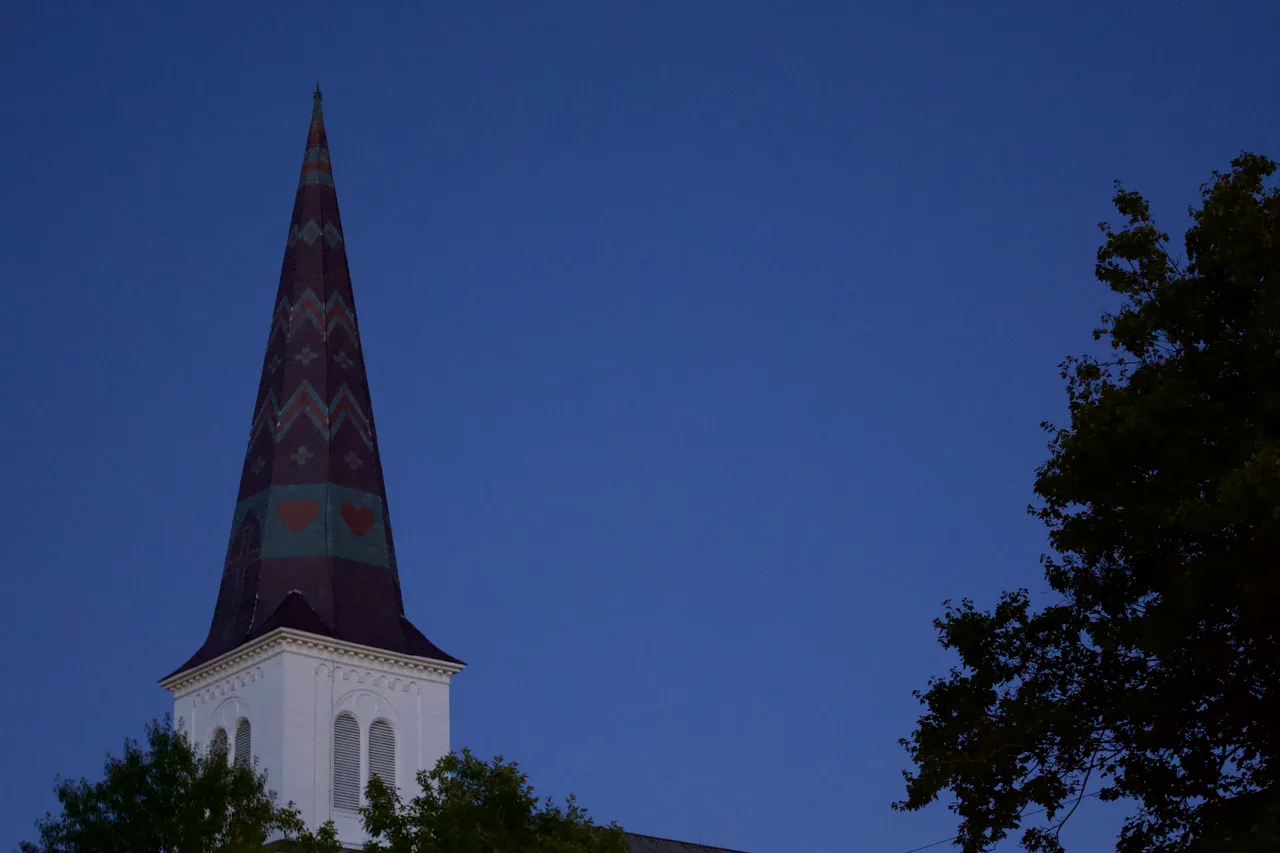
To me, it's art. Not because of the picture, but because of what I felt when I was taking it. I think looking at this picture, you can tell I was there. I was feeling something. It moved me. Art is just the transference of that brief feeling.
In The Creative Act, Rick Rubin argues that art is a side effect. The "content" is actually the result of living an artistic life.
How does one live an artistic life?
Home
I came home.
It all came back within a day. The dishes. The robot vacuum that refused to dock. The last roll of toilet paper, used, and nobody had ordered more. People to follow up with. Bills. The heaviness.
And I wondered how anyone lives an artistic life in the middle of all this.
I kept thinking about Paterson, the Jim Jarmusch film where Adam Driver plays a bus driver who writes poems in a notebook between shifts. Poems no one will ever read.
Is that what we should be aiming for? Small pieces of art that no one will ever see? Small proofs that I was alive for a brief moment? It begs the question. If paying attention is the point, how do I do this, how do I live an inspired life, in the middle of a modern American city? The cars are loud. Social media is loud. The stress is deafening. I live near one of the most beautiful mountain ranges in the world, and most days I don't see it. The bills don't go anywhere. Even the chores have their own steady, immovable noise.
Paying attention feels like a Herculean task, at least for my meagre willpower. From the research:
Picasso is often credited with saying that inspiration exists, but it has to find you working. Donna Tartt takes roughly a decade to write each novel, much of it longhand in notebooks. Leonard Cohen reportedly wrote dozens of verses for "Hallelujah" over several years before he had the song. None of them waited to feel "inspired." The attention came from the habit, not the other way around.
The science has a few things to add. The neuroscientist Mary Helen Immordino-Yang found that more complex feelings like admiration or awe take the brain several seconds longer to form than our reactions to simple facts. She worried that a life of fast scrolling might not leave time for them to arrive at all.
Place matters too. Rachel and Stephen Kaplan found that nature restores our ability to focus, while busy cities wear it down. And in a 2020 study, older adults took a fifteen-minute "awe walk" once a week, simply noticing what was around them. After eight weeks they reported more joy and less daily distress. Not a week in Vermont. Fifteen minutes. Julia Cameron, in The Artist's Way, suggests something similar for artists: a weekly "artist date," an hour alone doing something that delights you, just to refill the well.
So here are my experiments.
- Keep it simple. The noticing can't be some grand effort. Keep the photos coming. A strange leaf, an odd crack in the pavement, a man with an interesting face at a bus stop.
- Study something. I'm studying photographic minimalism: pictures built from only three elements, color, texture and shape. That's it. Go deep. Understand the first principles.
- Develop my taste. My voice is small, tiny in fact. That voice that feels the shape of a room, that senses the quiet beauty in a tree swaying in the wind, that sees the sublime in the ordinary. That voice is easily drowned out. That voice speaks in feelings, not words. Words have a way of boxing things in. Focus on the feeling itself, the shape of it, the unnamable form, the sensation. Feel deeply.
So now I'm back in my life. It was here waiting for me the whole time. I went to Alki with the kids on Sunday. We looked at sea anemones, seagulls surfing the small waves, a glimmering sea underneath the hazy mountains. I took out my camera, just my phone this time, and I tried to continue the noticing I did in Vermont. It worked.
I published the photos. The toilet paper was ordered. It was a good day.